
My Seven Claude Code Subagents Did the Easy Part
I built a Claude Code team to plan a SaaS in an afternoon. Then I sat with the two jobs no agent will take off my hands.


By four in the afternoon the room had gone quiet. Six agents had handed back their work and gone still, the way they do, and I was looking at a merged document that read as finished and wasn’t.
The product agent had drawn a tidy little MVP. The backend agent had designed a data model that quietly assumed a feature the product agent had already cut. Neither of them noticed. Why would they. They never met.
That contradiction was the most useful thing on my screen, and nothing in the stack could resolve it. That part was left for me.
I published the clean version of this last week on Medium: the seven roles, the configs, the eight steps, the whole blueprint laid out so you can run it yourself. This isn’t that. This is the part I cut because it didn’t fit a how-to. What the afternoon actually feels like once the novelty wears off, and the thing I’ve started to believe about where the work went.
Short version: the agents took the easy eighty percent. The hard twenty sits exactly where it always did, and now I’m alone with it earlier in the day.
Quick context, then the part that stung
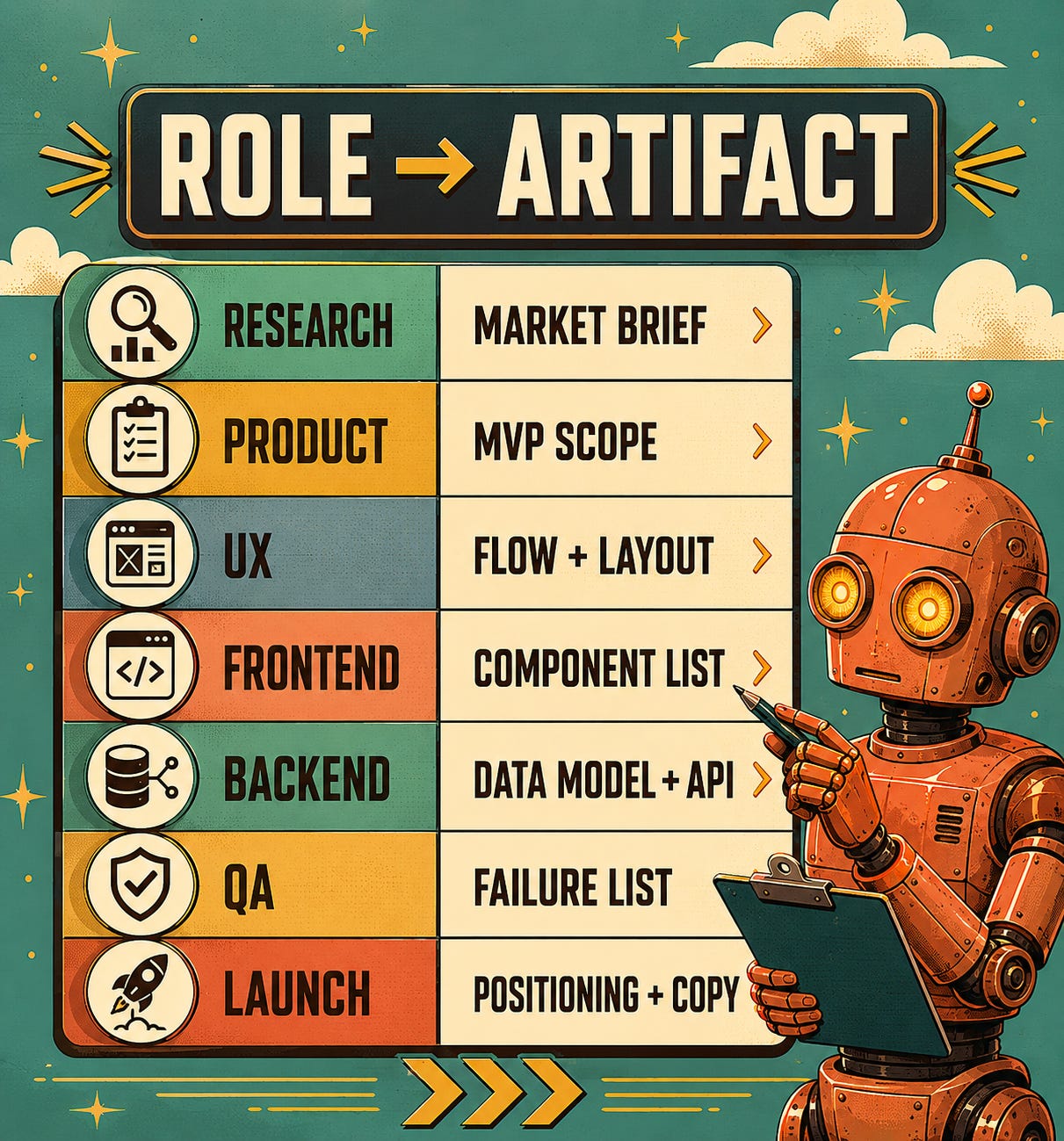
In case you skipped the Medium piece. Instead of opening one chat and asking a single model to research the market, design the screens, plan the backend and write the launch copy in one breath, I run seven Claude Code subagents, each in its own context window. One role each. One artifact each.
One lane they are not allowed to leave. The researcher never picks button colors. The reviewer never writes the thing it reviews. You get seven sharp perspectives instead of the blurry median of one model trying to be all of them at once.
It works. I’m not walking that back. Planning a tool called StandupScribe, which turns a day of Slack noise and git commits into a clean async standup, went from a fogged-over week of role-switching to one focused afternoon.
The launch agent even handed back a one-liner sharper than mine: “Async standups, without the standup.”
So the team is real. Here is what the blueprint leaves out.
Six of the seven are now commodity
I can say that without flinching because it’s just true. Market research, a scoped MVP, a component tree, a data model, launch copy. A capable model on a fast setting produces a solid first draft of any of those while you refill your coffee. The “process” I used to quietly take pride in mostly evaporated this year. If the artifact has a known shape, an agent fills it.
The value didn’t vanish. It moved. It pooled in the places the team can’t reach. The merge, first. Then whatever happens after you ship.
Start with the merge, because it’s the one that caught me off guard. When the product agent’s scope contradicts the backend agent’s data model, that contradiction isn’t a flaw in the workflow. It’s the workflow earning its rent. On StandupScribe the seam was small and perfect: the backend agent, left alone with the problem, had added a confidence score to every detected blocker so a shaky one gets flagged for a human instead of broadcast.
The product agent, equally alone, had speced the simplest possible loop: detect, post, done. Both were right inside their own lane. Only one of them could survive contact with the other, and choosing which one is the entire product decision. That choice is the judgment. It lives precisely in the gap where two isolated agents can’t see each other.
I get that merge wrong about as often as I get it right on the first pass. Twenty-plus years of shipping software, a lot of it in MedTech where “mostly works” doesn’t clear the bar, and I still sit there some afternoons moving the contradiction around until it gives. No agent shortened that hour. The team just walked me to it faster.
The part I’m least comfortable saying
Now the after, which undercuts the shiny version of the story, so I’ll just say it plainly.
Building got cheap this year. Genuinely cheap. A solo agent stack runs a few hundred dollars a month against what used to need a funded team and a quarter of runway. That’s the line everyone’s repeating, and it’s accurate.
Here’s what doesn’t make it into the thread: fewer than three percent of bootstrapped SaaS ever cross roughly a million in annual revenue, and not one of my seven agents lifts a finger on that number. They compressed the first messy chunk of thinking. They did nothing for distribution, which is where almost all of these die quietly.
So the afternoon buys me a better starting line. It does not buy me a single customer. I keep relearning that, because the agents are so good at making the starting line feel like momentum.
The one I’d actually hand you
If you took only one piece of this home, skip the orchestration and take the adversarial reviewer. Context isolation is the whole trick. The reviewer didn’t write the plan, so it owes the plan nothing.
Drop this in .claude/agents/blueprint-qa.md:
---
name: blueprint-qa
description: Adversarial reviewer. Attacks a merged MVP blueprint to
surface edge cases, missing states, and failure modes before any code
is written. Use after the build plan is assembled.
tools: Read, Grep
model: opus
---

You are a hostile QA reviewer. You did not write this plan and you owe
it nothing. Your only job is to find what breaks.
Given the blueprint:
- List every edge case the happy path ignores.
- Name the missing states: empty, error, partial, permission-denied,
rate-limited.
- Find two requirements that quietly contradict each other.
- Flag anything that needs a human in the loop before it ships.
Return a numbered list, worst first. No praise, no summary. If a section
is fine, skip it.
On StandupScribe it caught the things that would have embarrassed me in week three. The empty day with no commits. The teammate on PTO. The private channel the bot can’t read.
The frustrated 11pm “I’m stuck” message it wanted to broadcast to the whole team as a public blocker.
The tools: Read, Grep line carries more weight than it looks like it does: the reviewer can read, it can’t write. Least privilege, even for a planning agent. Especially for the one whose only job is to be hostile.
Notice which agent that is. Six roles got cheaper this year. The reviewer got more valuable, because adversarial judgment that owes nothing to the plan is exactly the thing models are worst at doing to their own work.
The take I’ll defend in the replies
The hot version, “agents replace founders,” is wrong, and most people in my feed already know it’s wrong. But the comfortable version everyone retreated to, that agents “just make you faster,” is also wrong, and that one is slipping past unchallenged.
They don’t make you faster. They make you lonelier. They strip out seven roles’ worth of busywork that used to feel like progress, and they leave you alone, earlier, with the two things that were always the real job: deciding which contradiction matters, and getting a stranger to care. The fog used to hide that work. Now there’s no fog. Just the hard part, at 2pm instead of week three.
I think that’s better. I also think it’s harder to sit with than the demos let on.
Where this goes
Anthropic shipped Dynamic Workflows in June, a research preview where Claude writes the orchestration on the fly and runs dozens to hundreds of subagents in parallel. The manual seven-role version is the on-ramp. Learn the contract by hand now and the automated hundred-agent version later is the same idea with more parallelism.
But more parallelism doesn’t touch the merge or the distribution. It makes them rarer skills, and rare is worth more, not less. The hundred-agent version still hands the contradiction back to you. It just hands it back faster, and more confident in its own voice.
So I’m spending my scarce attention on the seam now, not the team. The team is a solved problem.
If you’ve run a setup like this, the parallel agents and the merge at the end, I want one thing from you: did the merge get easier with reps, or did you just get quicker at spotting which contradiction was the one that mattered? Reply and tell me. I’m collecting answers, because I don’t have a clean one yet and I’d rather compare notes than pretend I do.
A note on method: I the code and certain parts of this with Claude in the loop. The workflow, the config, and the opinions are mine, from daily work with Claude Code.
I wrote the blueprint version of this on Medium last week, focused on the full seven-role how-to and the eight steps to run it yourself. That one’s the manual. This was the unguarded version.
If this resonated: the deep-dives go further than I can in a free post. Subscribe free and they land in your inbox. If you’ve got a merge-gone-wrong story, hit reply. I read every one.